
A2P SMS services let businesses send text messages automatically from their own software, rather than typing them by hand. A2P stands for application-to-person, and it covers one-time passcodes, order updates, payment alerts, and reminders that arrive the moment something happens in an app. For businesses in Ghana that want to reach customers quickly and at scale, A2P SMS is the engine behind almost every automated text they receive.
This guide explains what A2P SMS services are, how they differ from ordinary texting, what businesses use them for, and how the automation works behind the scenes. It is written for business owners, marketing teams, and developers, and it assumes no technical background.
What A2P SMS services are
A2P SMS is a text message sent by an application to a person. Instead of someone tapping out a message on a phone, a business system generates and sends it automatically. When you get a code to confirm a login, a note that your order has shipped, or a reminder about tomorrow's appointment, that is A2P SMS at work.
The opposite is P2P, person-to-person, which is the everyday texting you do with friends and family. The difference matters because A2P is built for reliability and scale. It uses a registered sender ID so your brand name shows up; it connects through an API so your systems can trigger messages on their own; and it routes through infrastructure designed to deliver high volumes dependably.
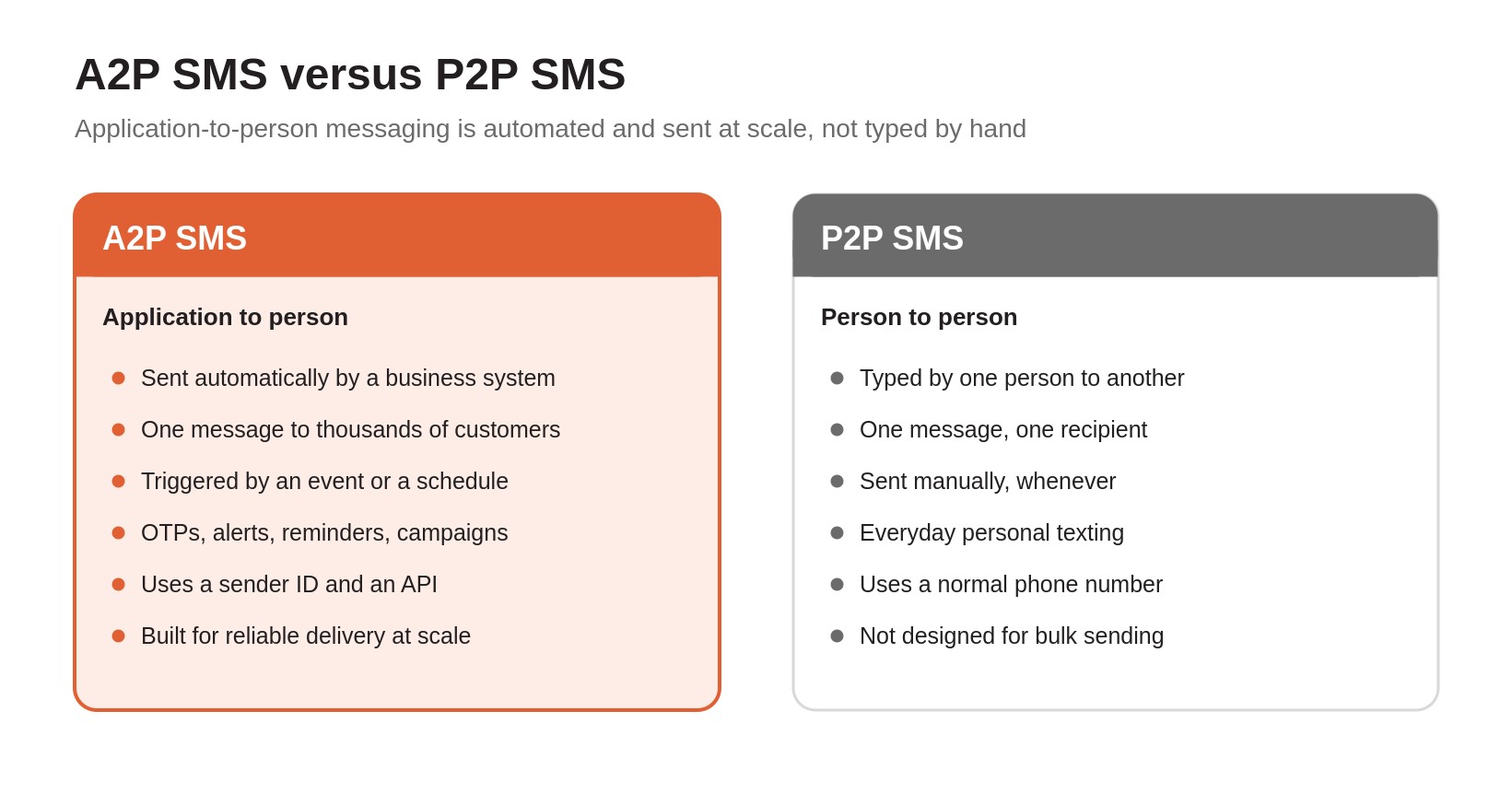
A2P messaging is automated, branded, and built for scale. P2P is ordinary personal texting.
Why automate customer communications
Sending messages by hand does not scale. A team can manage a handful of texts, but not thousands of order confirmations or a passcode for every login across the day. Automation removes that ceiling. The message goes out the instant it is needed, to as many customers as needed, worded the same way every time.
Timing is the other gain. A delivery alert is useful when the parcel is on its way, not an hour later when someone gets around to sending it. A one-time passcode is only useful in the moment. Automated A2P messaging fires on the event itself, so the message lands when it still matters.
| Manual sending | A2P automation |
Speed | Slow, one at a time | Instant, triggered by events |
Scale | Limited by staff time | Thousands at once |
Consistency | Varies by person | Same message every time |
Timing | Whenever someone remembers | Exactly when the event happens |
Tracking | Hard to measure | Delivery receipts and reports |
Automation changes messaging from a manual chore into a fast, consistent, measurable process.
What businesses automate with A2P SMS
The range is wide, but most A2P traffic falls into a few reliable categories. Each one solves a specific business problem, and most companies run several at once.
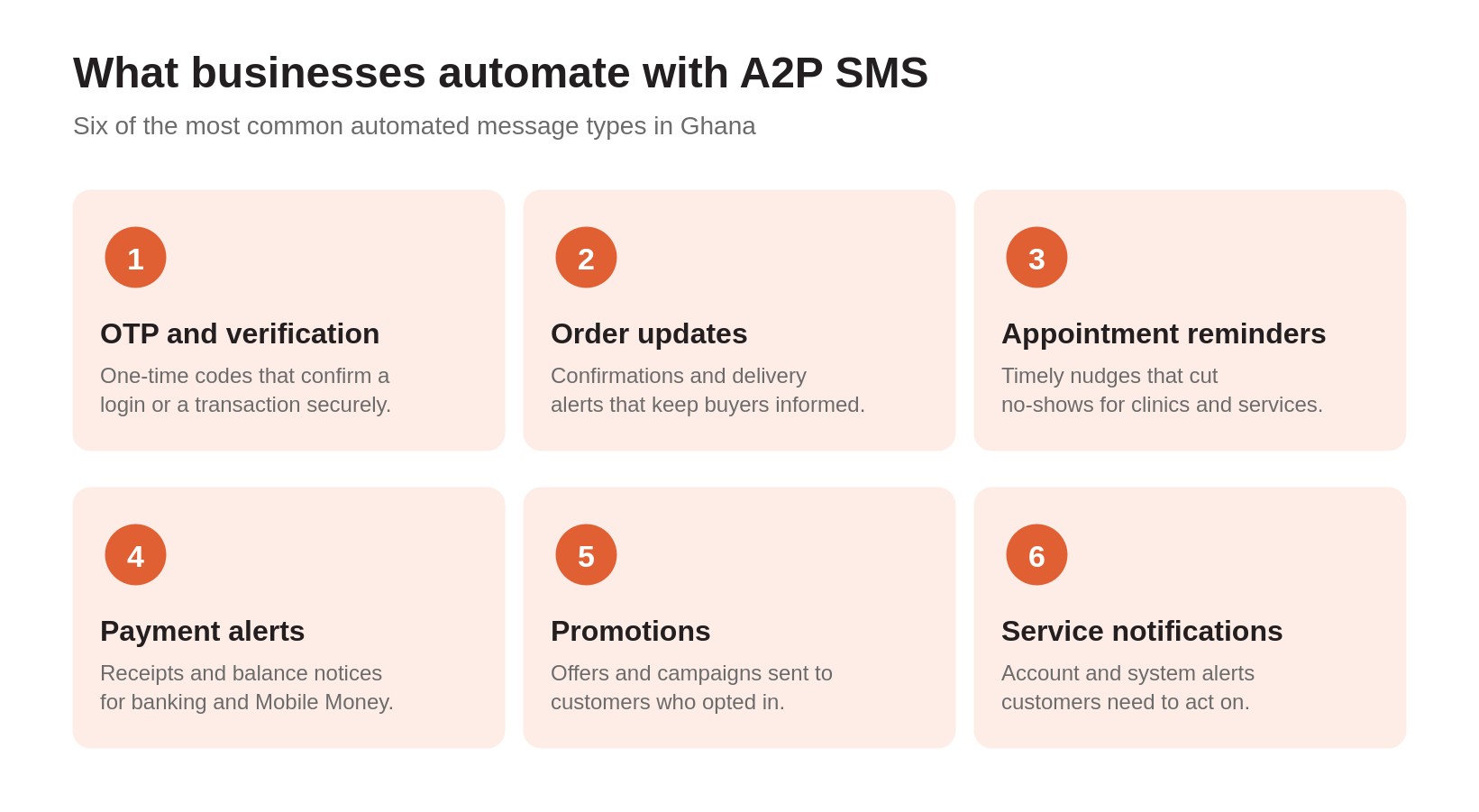
The most common things businesses in Ghana automate with A2P SMS.
Verification is one of the biggest. Sending an OTP SMS delivery to confirm a login or a Mobile Money transaction is A2P at its most time-sensitive. Order and delivery updates keep e-commerce customers informed. Appointment reminders cut no-shows for clinics and service businesses. Payment alerts confirm that money moved, which matters in a market where Mobile Money is everywhere.
These transactional messages are usually handled as transactional SMS, while offers and campaigns run as promotional SMS to customers who opted in. Keeping the two separate helps delivery, because they carry different expectations.
How A2P SMS automation works
The mechanics are simpler than they sound. Something happens in your system, your system tells the messaging platform to send a text, and the platform delivers it. All of this takes seconds and needs no human involvement once it is set up.
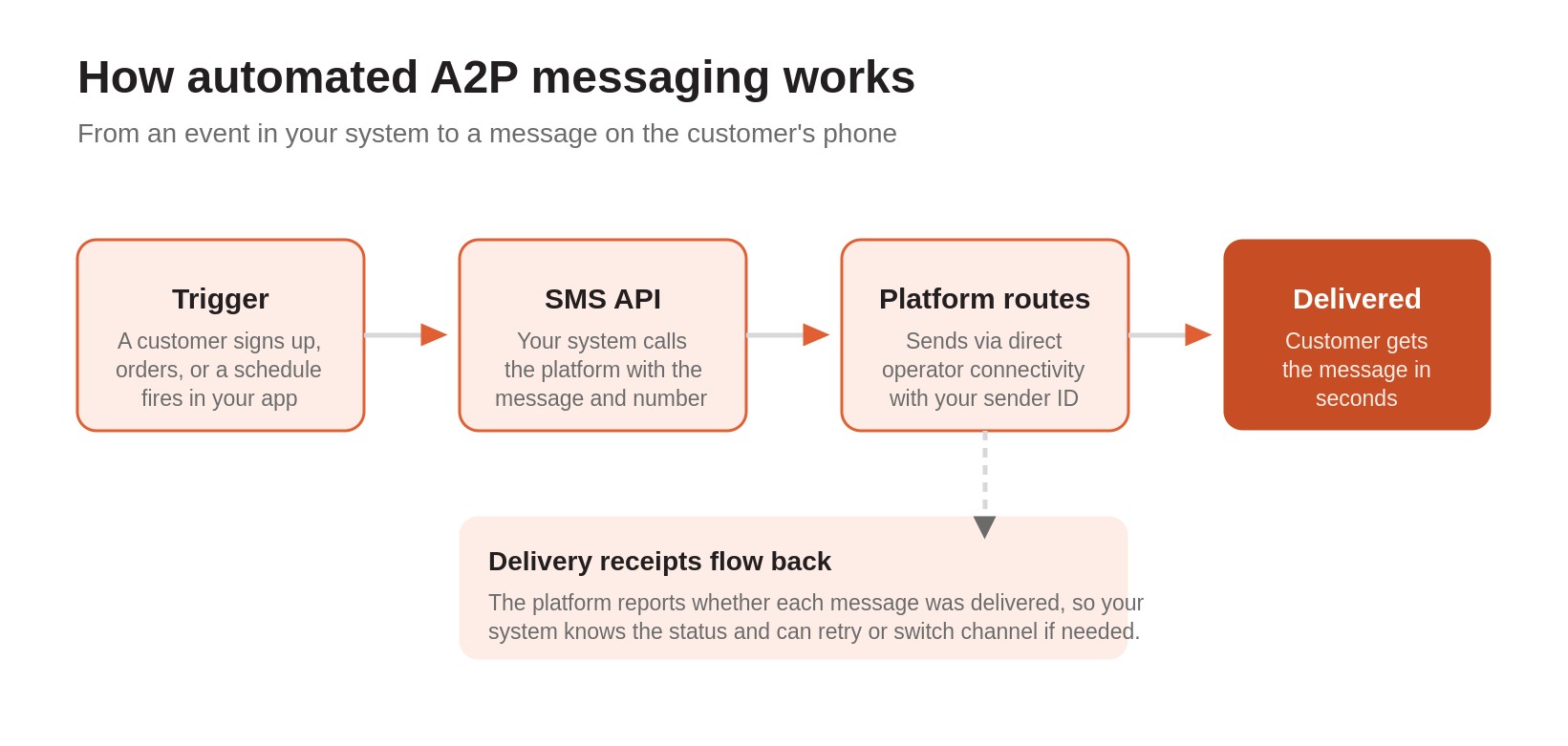
An event triggers the message, the API carries it, the platform delivers it, and receipts flow back.
The connection between your software and the messaging platform is an API. Africala's SMS API lets your application send a message with a single request: here is the number, here is the text, send it. The platform then routes it through direct operator connectivity with your sender ID attached, and reports back whether it was delivered. Those delivery receipts let your system react, for example, by retrying or switching to another channel if a message does not land.
For businesses that do not want to build against an API directly, the same messages can be sent from a web dashboard, either one campaign at a time or scheduled in advance. Either way, the automation and the delivery infrastructure are the same underneath.
A2P SMS and good practice in Ghana
Ghana has high mobile reach and a busy digital economy, from Mobile Money to online shopping, which makes A2P SMS a natural fit for reaching customers. It also means the usual rules of responsible messaging apply. Operators and regulators expect businesses to identify themselves, message only people who agreed to hear from them, and avoid spamming.
Requirements around sender registration, consent and content are set by operators and can change over time, and they are not identical to other markets. If you are unsure how a specific rule applies to your business, confirm it for your own situation rather than assuming. The general principle is steady everywhere: be recognisable, be wanted, and make it easy to opt out.
Best practices for A2P SMS
Automation multiplies whatever you set up, good or bad. A well-designed A2P programme reaches customers with messages they value. A careless one annoys people and gets filtered. The difference comes down to a few habits.
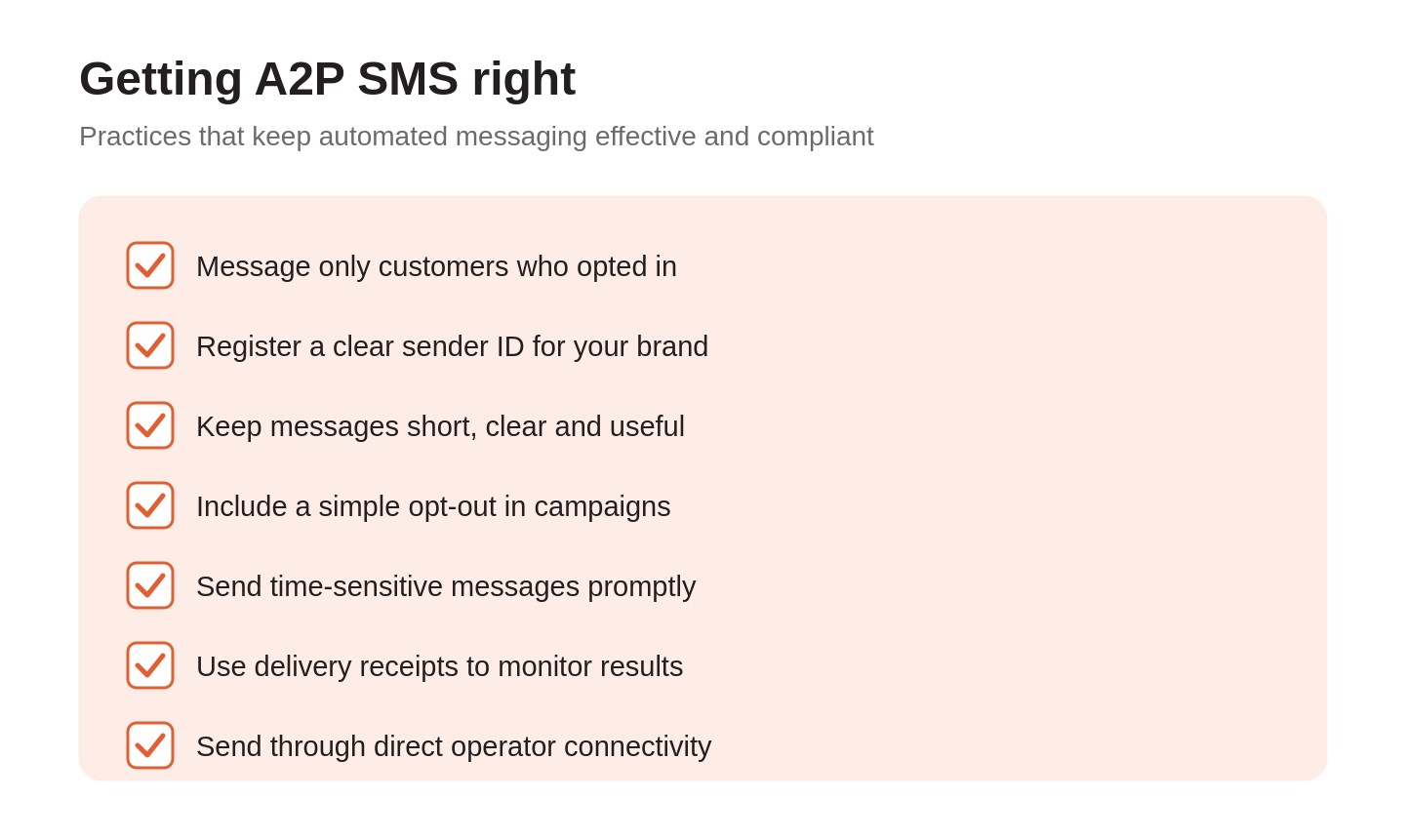
Follow these to keep automated messaging effective, trusted and compliant.
● Message only customers who opted in, and keep a record of that consent.
● Register a clear sender ID so your brand name is recognised and trusted.
● Keep each message short, specific and genuinely useful to the person receiving it.
● Include a simple opt-out in promotional messages so people can stop them easily.
● Send time-sensitive messages like codes and alerts promptly, through a fast route.
● Use delivery receipts to monitor performance and spot problems early.
How Africala helps you automate messaging
A2P SMS only works if the messages actually arrive, which is where the platform matters. Africala helps businesses in Ghana automate customer communications through direct operator connectivity, registered sender IDs, and clean routing, so automated messages are delivered quickly and consistently at any volume. Whether you are sending verification codes, order updates, or bulk SMS in Ghana for a campaign, the delivery layer is built for it.
Developers can trigger messages straight from their own systems, and for messaging that invites a reply, two-way sms turns a one-way alert into a conversation. Keeping strong data protection and fraud prevention practices around it all protects both your customers and your sender reputation, which is part of what keeps delivery healthy over time.
If you want to automate the messages your business sends, or improve the delivery of the ones you already send, talk to the Africala team about your use case and volumes.
Frequently asked questions
What does A2P SMS mean?
A2P stands for application-to-person. It is a text message sent automatically by a business application to a customer, such as a verification code or an order update. It is different from P2P, person-to-person, which is the everyday texting people do manually with each other.
What is the difference between A2P and P2P SMS?
A2P SMS is automated, sent from a business system through an API or platform, usually with a registered sender ID and at scale. P2P SMS is typed by one person and sent to another from a normal phone number. A2P is built for reliable bulk and transactional messaging, while P2P is for personal conversation.
What can businesses use A2P SMS for?
Common uses include one-time passcodes for verification, order and delivery updates, appointment reminders, payment and account alerts, service notifications, and opted-in promotional campaigns. Most businesses run several of these at once from the same platform.
Do I need developers to use A2P SMS?
Not necessarily. Developers can integrate an SMS API to trigger messages directly from your systems, which is ideal for automation like OTPs. If you do not have developers, you can send and schedule messages from a web dashboard instead. Both approaches use the same delivery infrastructure.
How fast does an A2P SMS get delivered?
Through a good route with direct operator connectivity, delivery is usually within seconds. Speed matters most for time-sensitive messages like verification codes. Sending through a trusted platform rather than an unpredictable route is the main way to keep delivery fast and consistent.
How do I keep automated messages from being marked as spam?
Message only people who opted in, use a registered sender ID, keep the wording clear and relevant, and include an easy opt-out in promotional messages. Automated messages that are expected and useful are far less likely to be filtered than unsolicited bulk sends.